
Online-Katalog
24. Juni 2026 - Basel Watch Auction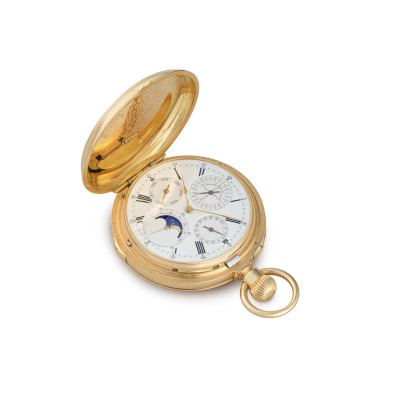
Swiss owner
The movement belongs to the tradition of highly complicated watches produced by the great Vallée de Joux workshops during the late nineteenth and early twentieth centuries. Such watches were created in extremely limited numbers and required hundreds of hours of specialist labour. The grande sonnerie automatically strikes both the hours and quarters in passing, while the petite sonnerie omits the repetition of the hours at each quarter. The inclusion of a silence option, perpetual calendar and lunar display places this watch among the elite category of complicated portable timekeepers produced before the advent of wristwatch dominance.
Of even greater significance is its presentation inscription linking the watch directly to one of Britain's most celebrated pre-war boxers, Matt Wells. The watch commemorates Wells's victory over Freddie Welsh on 27 February 1911, a contest that secured for Wells the Lightweight Championship of Great Britain and represented one of the defining moments of his professional career.
At the beginning of the twentieth century, presentation watches of this quality were among the most prestigious awards that could be bestowed upon sporting champions. The choice of a complicated gold sonnerie watch from one of Switzerland's foremost makers demonstrates the esteem in which Wells's achievement was held and transforms the present piece from an important horological object into a document of national sporting history.
Complicated Audemars pocket watches with confirmed historical presentation inscriptions are exceptionally rare. Examples combining grande and petite sonnerie, perpetual calendar and documented sporting provenance are rarer still. The present watch therefore represents an outstanding opportunity to acquire a museum-quality complicated timepiece united with an important chapter in the history of British boxing.
Matt Wells: England’s Boxing Champion
Matt Wells (1886–1953) was one of Britain’s most accomplished early professional boxers and remains an important figure in both English sporting history and the Jewish community. Born in Walworth, London, Wells rose from a successful amateur career to become one of the leading fighters of his generation. He won multiple Amateur Boxing Association titles before representing Great Britain at the 1908 Olympic Games.
Turning professional in 1909, Wells quickly established himself as a top-class boxer. In 1911, he defeated Freddie Welsh to win the British Lightweight Championship, a remarkable achievement during an era when British boxing was gaining international recognition. Three years later, in Sydney, Australia, he defeated Tom McCormick to claim the World Welterweight Championship, as well as the British and Empire welterweight titles.
As a proud Jewish athlete, Matt Wells occupies a special place in Jewish sporting history. At a time when Jewish sportsmen often faced social prejudice and limited opportunities, Wells became a symbol of excellence and determination. His success demonstrated that Jewish athletes could compete and triumph at the highest levels of international sport. His achievements have been recognised by the International Jewish Sports Hall of Fame, which inducted him in 2007.
Wells is also listed among notable British Jewish sports figures, alongside other celebrated Jewish boxing champions such as Daniel Mendoza and Ted “Kid” Lewis. His accomplishments helped establish a proud tradition of Jewish participation in British boxing and inspired future generations of Jewish athletes.
Today, Matt Wells is remembered not only as a world champion boxer but also as a pioneering figure whose achievements brought honour to both England and the Jewish community. His legacy continues to be celebrated as an example of sporting excellence, perseverance, and cultural pride.
Ls. Audemars Brassus & Genève
No. 12126, circa 1911
Historical 18k Gold Grande and Petite Sonnerie Perpetual Calendar Pocket Watch Presented to the British Lightweight Boxing Champion Matt Wells
Case: hunting cased, polished and engine-turned gold case with finely executed basket-weave guilloché decoration to both covers, the front cover centred by a vacant circular cartouche, the band fitted with a slide activating the quarter repeating mechanism, corrector on the edge of the dial to adjust the Petite and Grande Sonnerie, maker’s hallmark inside
Cuvette : engraved inside the cuvette to commemorate the special boxing event : Presented to MATT. WELLS on the occasion of his victory over FRED WELSH for the Lightweight Championship of Great Britain. February 27th 1911.
Dial: white enamel dial with Roman numerals, outer minute track and four subsidiary indications comprising perpetual calendar in sub counters inidcating the date, days of the week, month, leap year and phases of the moon, blued-steel and gold hands, outer minute track
Movement: gilt movement of exceptional quality, jewelled throughout and fitted with the complex sonnerie and perpetual calendar mechanism characteristic of the finest productions of the Vallée de Joux during the early twentieth century
Dimensions: 56 mm
Weight: 217,7 g
CHF 15'000 – 30'000
Verkauft fürCHF 82'566
Swiss owner
The movement belongs to the tradition of highly complicated watches produced by the great Vallée de Joux workshops during the late nineteenth and early twentieth centuries. Such watches were created in extremely limited numbers and required hundreds of hours of specialist labour. The grande sonnerie automatically strikes both the hours and quarters in passing, while the petite sonnerie omits the repetition of the hours at each quarter. The inclusion of a silence option, perpetual calendar and lunar display places this watch among the elite category of complicated portable timekeepers produced before the advent of wristwatch dominance.
Of even greater significance is its presentation inscription linking the watch directly to one of Britain's most celebrated pre-war boxers, Matt Wells. The watch commemorates Wells's victory over Freddie Welsh on 27 February 1911, a contest that secured for Wells the Lightweight Championship of Great Britain and represented one of the defining moments of his professional career.
At the beginning of the twentieth century, presentation watches of this quality were among the most prestigious awards that could be bestowed upon sporting champions. The choice of a complicated gold sonnerie watch from one of Switzerland's foremost makers demonstrates the esteem in which Wells's achievement was held and transforms the present piece from an important horological object into a document of national sporting history.
Complicated Audemars pocket watches with confirmed historical presentation inscriptions are exceptionally rare. Examples combining grande and petite sonnerie, perpetual calendar and documented sporting provenance are rarer still. The present watch therefore represents an outstanding opportunity to acquire a museum-quality complicated timepiece united with an important chapter in the history of British boxing.
Matt Wells: England’s Boxing Champion
Matt Wells (1886–1953) was one of Britain’s most accomplished early professional boxers and remains an important figure in both English sporting history and the Jewish community. Born in Walworth, London, Wells rose from a successful amateur career to become one of the leading fighters of his generation. He won multiple Amateur Boxing Association titles before representing Great Britain at the 1908 Olympic Games.
Turning professional in 1909, Wells quickly established himself as a top-class boxer. In 1911, he defeated Freddie Welsh to win the British Lightweight Championship, a remarkable achievement during an era when British boxing was gaining international recognition. Three years later, in Sydney, Australia, he defeated Tom McCormick to claim the World Welterweight Championship, as well as the British and Empire welterweight titles.
As a proud Jewish athlete, Matt Wells occupies a special place in Jewish sporting history. At a time when Jewish sportsmen often faced social prejudice and limited opportunities, Wells became a symbol of excellence and determination. His success demonstrated that Jewish athletes could compete and triumph at the highest levels of international sport. His achievements have been recognised by the International Jewish Sports Hall of Fame, which inducted him in 2007.
Wells is also listed among notable British Jewish sports figures, alongside other celebrated Jewish boxing champions such as Daniel Mendoza and Ted “Kid” Lewis. His accomplishments helped establish a proud tradition of Jewish participation in British boxing and inspired future generations of Jewish athletes.
Today, Matt Wells is remembered not only as a world champion boxer but also as a pioneering figure whose achievements brought honour to both England and the Jewish community. His legacy continues to be celebrated as an example of sporting excellence, perseverance, and cultural pride.