
Catalogue en ligne
24 juin 2026 - Basel Watch Auction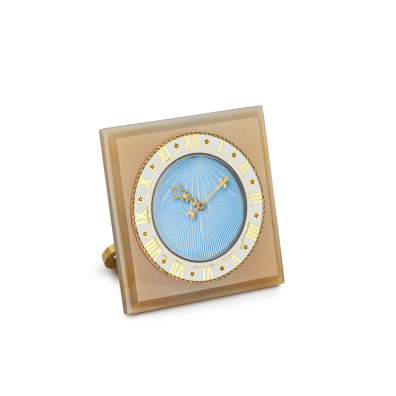
Swiss Owner
The years immediately following 1918 represent one of the most fertile periods in Cartier's history. Under the direction of Louis Cartier, the Maison developed a remarkable series of desk clocks, mystery clocks and luxury objects that transformed functional timepieces into works of decorative art. Drawing inspiration from Islamic art, Chinese and Japanese decorative traditions, Egyptian motifs and contemporary geometric design, Cartier produced clocks that rank among the most innovative creations of twentieth-century decorative arts.
The present clock embodies this spirit of experimentation. The use of agate as the principal architectural element reflects Cartier's celebrated mastery in the incorporation of hardstones, a field in which the firm achieved unparalleled distinction during the first quarter of the twentieth century. The luminous translucent agate provides a subtle counterpoint to the brilliant white enamel chapter ring and the striking blue guilloché enamel centre.
Particularly noteworthy are the highly unusual moon-and-star hands. Such celestial imagery occupied a special place within Cartier's decorative vocabulary during the 1910s and 1920s, reflecting both the Maison's fascination with exoticism and the broader taste for symbolic and fantastical motifs among its international clientele. The elegant asymmetry of the hands introduces an element of whimsy into an otherwise rigorously geometric design.
Produced in Paris most probably in 1921 as mentionned in the archives duplicate paper, the present clock belongs to the golden age of Cartier's decorative production, a period that also witnessed the creation of some of the Maison's most celebrated mystery clocks and hardstone objets. Its harmonious combination of agate, enamel and finely executed metalwork demonstrates the extraordinary level of craftsmanship for which Cartier became renowned among the leading collectors, aristocrats and industrialists of the early twentieth century.
Today, early Cartier desk clocks of this quality and originality with a presentation box from the period are encountered only rarely on the market. The present example survives as an elegant testament to the Maison's ability to unite horology, precious materials and decorative imagination in a single object of enduring sophistication.
Cartier, Paris
No. 698, circa 1921
An Art Deco desk clock with white enamel bezel and translucent blue enamel dial
Case: square-form desk clock constructed from a finely polished translucent agate plaque, the front centred by a circular white enamel chapter ring with Roman numerals and delicate floral markers
Dial: pale blue translucent enamel fitted with highly unusual pierced hands formed as a crescent moon and star, a poetic celestial motif characteristic of Cartier's fascination with Orientalist and astronomical themes
Movement: reverse fitted with a movement with a circular gilt-metal cover, enclosing a mechanical manual movement, the case supported by an integrated easel stand engraved Cartier Paris and numbered 698.
Dimensions: 74 x 74 mm
Accessories: with an original red leather presentation box from the period and paper duplicate stamped from Cartier Gstaad with a signature mentioning archives “PENDULETTE Carrée en agate à moulure coins vifs. Cadran bord émail blanc, chiffres romains or, centre azur. Aiguilles or. Cartier No. 068 / (698). 1921.
*CHF 25'000 – 50'000
Swiss Owner
The years immediately following 1918 represent one of the most fertile periods in Cartier's history. Under the direction of Louis Cartier, the Maison developed a remarkable series of desk clocks, mystery clocks and luxury objects that transformed functional timepieces into works of decorative art. Drawing inspiration from Islamic art, Chinese and Japanese decorative traditions, Egyptian motifs and contemporary geometric design, Cartier produced clocks that rank among the most innovative creations of twentieth-century decorative arts.
The present clock embodies this spirit of experimentation. The use of agate as the principal architectural element reflects Cartier's celebrated mastery in the incorporation of hardstones, a field in which the firm achieved unparalleled distinction during the first quarter of the twentieth century. The luminous translucent agate provides a subtle counterpoint to the brilliant white enamel chapter ring and the striking blue guilloché enamel centre.
Particularly noteworthy are the highly unusual moon-and-star hands. Such celestial imagery occupied a special place within Cartier's decorative vocabulary during the 1910s and 1920s, reflecting both the Maison's fascination with exoticism and the broader taste for symbolic and fantastical motifs among its international clientele. The elegant asymmetry of the hands introduces an element of whimsy into an otherwise rigorously geometric design.
Produced in Paris most probably in 1921 as mentionned in the archives duplicate paper, the present clock belongs to the golden age of Cartier's decorative production, a period that also witnessed the creation of some of the Maison's most celebrated mystery clocks and hardstone objets. Its harmonious combination of agate, enamel and finely executed metalwork demonstrates the extraordinary level of craftsmanship for which Cartier became renowned among the leading collectors, aristocrats and industrialists of the early twentieth century.
Today, early Cartier desk clocks of this quality and originality with a presentation box from the period are encountered only rarely on the market. The present example survives as an elegant testament to the Maison's ability to unite horology, precious materials and decorative imagination in a single object of enduring sophistication.